Here's the thing about my first real audiogram — not just "restaurants are loud these days," the actual test. The audiologist turned the screen toward me like a mechanic showing me a diagnostic printout on my car, all these dots and X's sloping down toward the bottom right corner, and I nodded like I understood any of it. I did not. I went home and looked up half the words on that printout, and "ototoxicity" was not one I expected to need.
That appointment came about two years after the dinner where I missed my granddaughter's first full sentence — she said something to the whole table, everybody laughed, and I just smiled along, because asking "what did she say" for the third time that night felt worse than not knowing. My wife noticed before I did. She usually does.
Before I got real hearing aids I tried one of those forty-dollar drugstore sound amplifiers — the kind that clips over your ear like a Bluetooth headset from 2009. It made everything louder. The fridge. The dishwasher. A guy coughing three tables over. It did approximately nothing for actually understanding speech at a noisy table. Waste of forty bucks, lesson learned the expensive way.
So here's a list of the terms I wish somebody had handed me before that first appointment — not a textbook, just what's actually been explained to me over the last few years, checked against real sources this time instead of whatever I half-remembered from the waiting room pamphlet.
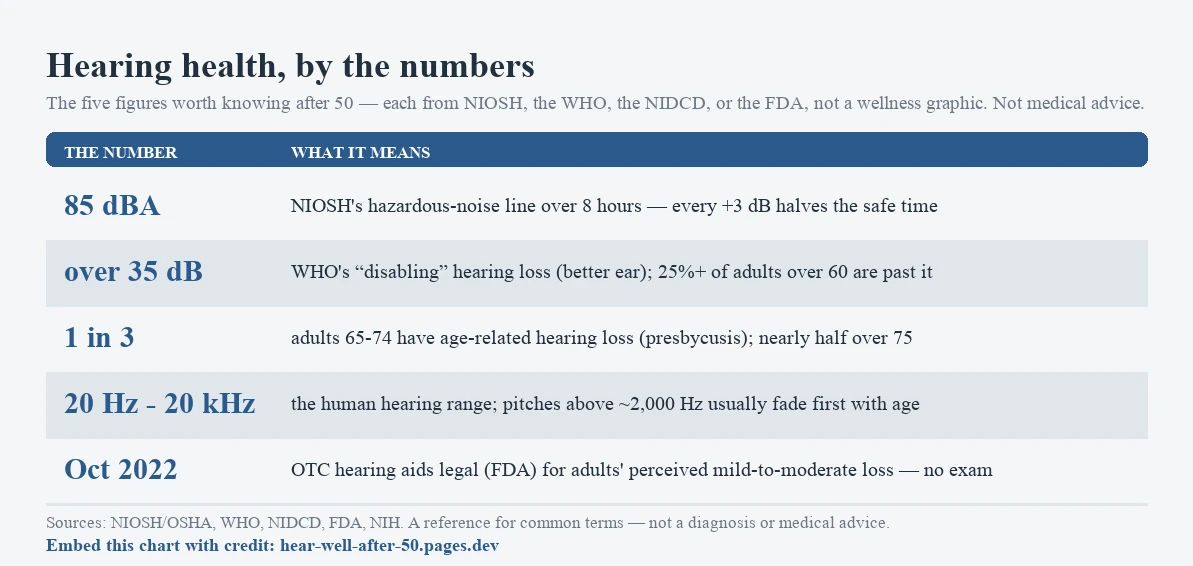
The hearing number worth knowing: 85 dBA is NIOSH's threshold for hazardous noise over an 8-hour day — and every 3 dB louder halves the safe exposure time. Age takes the high pitches first (sensitivity above ~2,000 Hz declines first), which is why 1 in 3 adults aged 65–74 already have age-related hearing loss, and nearly half of those older than 75.
Core Auditory Terminology
| Term | Definition and Technical Data |
|---|---|
| Audiogram | A graph displaying the results of a pure-tone hearing test. It plots the softest sounds an individual can hear at various frequencies (pitches) in each ear. Thresholds are measured in decibels (dB) relative to a standard "normal" hearing level (StatPearls/NIH). |
| Cochlear Implant | A complex electronic medical device that bypasses damaged portions of the ear to directly stimulate the auditory nerve. Unlike hearing aids, which amplify sound, implants provide a sense of sound by processing acoustic signals into electrical impulses (NIDCD). |
| Conductive Hearing Loss | Hearing impairment caused by an obstruction or damage in the outer or middle ear (e.g., fluid, earwax, or bone abnormalities) that prevents sound from reaching the inner ear. It is often distinguished from sensorineural loss during diagnostic testing. |
| Disabling Hearing Loss | A clinical threshold defined by the World Health Organization as hearing loss greater than 35 decibels (dB) in the better-hearing ear. Over 25% of adults older than age 60 are affected by this level of impairment (WHO). |
| Ototoxicity | The property of being toxic to the ear, specifically the cochlea or auditory nerve. Ototoxicity is a trait shared by aminoglycoside antibiotics, loop diuretics, platinum-based chemotherapy agents such as cisplatin, and some NSAIDs (PubMed/NIH). |
| Presbycusis | Age-related hearing loss characterized by a progressive, symmetrical loss of hearing sensitivity. It affects roughly 1 in 3 adults aged 65 to 74, and nearly half of those older than 75 (NIDCD). |
| Sensorineural Hearing Loss | Hearing loss resulting from damage to the inner ear (cochlea) or the nerve pathways from the inner ear to the brain. This is the most common type of permanent hearing loss and is typically the primary component of presbycusis. |
That first batch is the stuff that comes up when someone's actually diagnosing what's going on. The next batch is more the fine print — the numbers regulators and audiologists throw around that nobody ever explained to me either, until I asked.
Technical and Regulatory Specifications
| Parameter | Standard Values and Regulatory Data |
|---|---|
| Decibel (dB) | A logarithmic unit used to measure sound intensity. NIOSH identifies 85 A-weighted decibels (dBA) as the threshold for hazardous noise exposure over an 8-hour period. For every 3 dB increase above 85 dB, the safe exposure time is reduced by half (OSHA/NIOSH). |
| Frequency (Hertz/Hz) | The measurement of sound pitch. The standard human hearing range is about 20 Hz to 20 kHz (NIH). In age-related hearing loss, sensitivity above roughly 2000 Hz is typically what declines first (StatPearls/NIH). |
| OTC Hearing Aid Regulation | A regulatory category established by the U.S. Food and Drug Administration (FDA) for adults aged 18 and older with perceived mild-to-moderate hearing loss. The final rule became effective on October 17, 2022, allowing these devices to be sold without a medical exam or prescription (FDA). |
Last verified: 2026-07-12
One thing worth taking seriously: if you're on a loop diuretic for blood pressure or heart failure — something like furosemide — and you also end up on an aminoglycoside antibiotic or a high dose of ibuprofen or another NSAID, that combination is a well-documented one-two punch for your inner ear, on top of whatever risk cisplatin or another chemo drug already carries on its own. That's not a figure-it-out-yourself conversation. Talk to your doctor or pharmacist before you chalk up new ringing or hearing trouble to "just getting older," especially if you're juggling more than one prescription. Every set of ears is different, and mine are not a substitute for your own audiologist's opinion.
Sources
- StatPearls (NCBI Bookshelf): Audiogram Interpretation
- National Institute on Deafness and Other Communication Disorders (NIDCD): Cochlear Implants
- World Health Organization (WHO): Deafness and Hearing Loss Fact Sheet
- PubMed: In Vitro and In Vivo Models of Drug Ototoxicity
- National Institute on Deafness and Other Communication Disorders (NIDCD): Age-Related Hearing Loss (Presbycusis)
- Occupational Safety and Health Administration (OSHA): Occupational Noise Exposure
- NIH Bookshelf: The Audible Spectrum (Neuroscience)
- StatPearls (NCBI Bookshelf): Presbycusis
- U.S. Food and Drug Administration (FDA): OTC Hearing Aids: What You Should Know